

While preparing, with Art Olivier, a unique article about 9/11, I again divert briefly into classic Hollywood.
In early 2025, I wrote a post about the egregious discrimination that the 1951 Bible-era epic Quo Vadis received at the Academy Awards (0 wins out of 8 nominations) vs. 1959’s Ben Hur (11 wins out of 12 nominations). I also discussed this with Tim Kelly on his Our Interesting Times podcast.
As just one example, Quo Vadis, in recreating ancient Rome, set an all-time record with 32,000 original costumes, but was denied the “Best Costume Design—Color,” which went instead (along with five other Oscars) to An American in Paris, even though Gene Kelly spends much of the film walking around in a white shirt, white pants, and white baseball cap, while his love interest (Leslie Caron) wore outfits used by Elizabeth Taylor in a previous film. Later, Ben Hur would win “Best Costume Design,” even though most of its costumes were simply borrowed from those made for Quo Vadis.
The reasons for the discrimination appear to have been both religious and political. Quo Vadis was about the Roman persecution of Christians, while Ben Hur was about Roman persecution of Jews. Politically, Quo Vadis starred Robert Taylor, who had testified against communism before the House Committee on Un-American Activities, while An American in Paris starred Gene Kelly, perhaps the most notorious Hollywood leftist of his time.
When I was young, well over 50 years ago, two films were virtually guaranteed to be shown on television every Easter: The Ten Commandments and The Robe. Quo Vadis was notably absent.
It’s not my intention to slight the tastes of The Robe’s fans. However, I recently rewatched it after many years, and quickly noticed some of the same dynamics at play. Before getting into these, let’s quote what IMDB says about the film’s purported screenwriter, Philip Dunne:
In his memoirs, writer Philip Dunne strongly hinted that most of the work on the script had not been done by him (though he had sole credit), but by a writer who had been blacklisted for leftist beliefs. This was Albert Maltz, a lifelong Communist, who gained shared credit with Dunne on new prints of the film only some years after his death in 1985.

AI confirms that Maltz, one of the notorious “Hollywood Ten,” was Jewish. He wrote his ideological views into such films as the Frank Sinatra 10-minute short The House I Live in. The film is now in the public domain. I don’t think I need to tell anyone what the boy’s “religion” was or the intent of the aborted sentence “He’s a dirty ___!” In the guise of American justice and ideals, the film typified Hollywood’s aggressive postwar suppression of alleged “antisemitism”:
Trivia note: The film lists “Lewis Allan” as the lyricist for “The House I Live In.” Allan’s real name was Abel Meeropol; he was the son of Jewish immigrants from Russia/Ukraine. After Julius and Ethel Rosenberg were executed for giving U.S. atomic secrets to the Soviet Union—not exactly the sort of patriotism the song and film expressed—Meeropol adopted their sons.
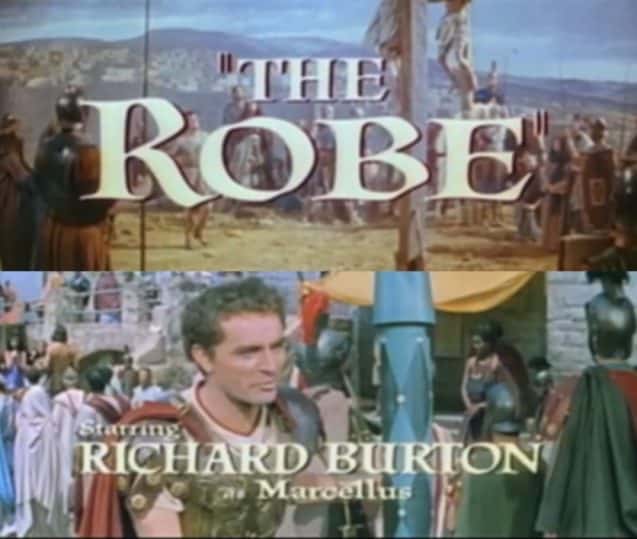
Why was Maltz, a Jewish Communist, tasked to write the script for a Christian epic like The Robe? The film did bear superficial resemblance to Quo Vadis. The former centered on a Roman general, Marcus Vincius (Robert Taylor) who converts to Christianity in spite of personal doubts and persecution by an emperor—Nero. In The Robe, a Roman tribune who takes part in the Crucifixion, Marcellus Gallo (Richard Burton) converts to Christianity in spite of personal doubts and persecution by an emperor—Caligula. But the resemblance pretty much stops there. I personally get the impression that The Robe was an inferior substitute, perhaps intended to help the public forget Quo Vadis.
In watching the two films, it’s clear (to me, subjectively) that Quo Vadis had superior scripting, directing and acting. Its Christian message is more heartfelt and convincing. At the end of The Robe, the instantaneous conversion of Marcellus’s girlfriend (Jean Simmons) to Christianity, and her walking beamingly to her death, seems unrealistic. (Instant conversions are documented in The Lives of the Saints, but usually only after the individual witnessed something miraculous.) Despite going on to be one of cinema’s most venerated actors, IMDB says The Robe’s Richard Burton
hated making the film so much that he turned down a contract from 20th Century-Fox. He was amazed to receive an Oscar nomination after critics had almost universally described his performance as “wooden.” He later said the film made him want to “throw up” and that it “was lousy, but an almighty hit. I was dull as ditchwater and an almighty flop.”
Ben Hur leaves viewers with the impression that the Crucifixion was entirely the work of Romans. The actual prime movers—Jews and Pharisees—are never mentioned in connection with it, and they are not seen jeering when Christ is on the Cross.
The Robe followed the same formula. When Tribune Marcellus Gallo (Burton) arrives in Palestine, he is almost immediately summoned by Pontius Pilate (Richard Boone), who orders him to crucify Christ. Pilate is seen washing his hands, with no context given. Jews and Pharisees are never mentioned. Pilate says “I’ve had a miserable night—factions, no one agreeing with anyone else.” But these factions are never named. The original 1942 novel The Robe (on which the film was based), written by longtime clergyman Lloyd C. Douglas, did not make this mistake. So besides being unfaithful to history, Maltz was unfaithful to the original book. The Robe was not the only novel Douglas wrote that was made into a movie. Wikipedia comments that “Douglas was generally unhappy with the film adaptations of his works.” So his death in 1951 might be one reason Maltz felt comfortable taking liberties with the screenplay.
In The Robe’s Crucifixion scene, there is no boisterous crowd—just a handful of reverent people, and the cruel, laughing Roman soldiers. As with Ben Hur, The Robe creates the illusion that there was never any animosity between Jews and Christians—hence bolstering the concept of “Judeo-Christianity”—and makes the Romans the sole perpetrators of the Crucifixion.
I believe The Robe’s Christian message was also blunted by making faith essentially secondary to an object portrayed as having supernatural powers—the robe of Christ, which Marcellus wins in a gambling match at the foot of the Cross.
For what it’s worth, I described the Orthodox Church’s view of the robe’s fate in my book Missing Saints, Missing Miracles:
- John 19:23-24 reads:
Then the soldiers, when they had crucified Jesus, took his garments, and made four parts, to every soldier a part; and also his coat: now the coat was without seam, woven from the top throughout. They said therefore among themselves, Let us not rend it, but cast lots for it, whose it shall be: that the scripture might be fulfilled, which saith, They parted my raiment among them, and for my vesture they did cast lots. These things therefore the soldiers did.
More than one account exists of this seamless tunic’s fate (some of my older readers will recall it was at the center of the 1953 Richard Burton film The Robe.) According to The Synaxarion [Lives of the Saints], its location was discovered in the fourth century by St. Nino, the great evangelizer of Iberia, now part of Georgia. While in the city of Mtshketa:
[She] began to preach the Gospel to both the pagans and the Jews of the city. She succeeded thus in converting Sidonia, the ruler of the synagogue’s daughter, and her father Abiathar. The latter told her how his grandfather Eliaz had been summoned to Jerusalem by the Jews to be present at Christ’s Passion, and that he had acquired the Lord’s tunic from the soldiers who had cast lots for it. On his return to Mtshketa, he had shown the precious relic to his sister Sidonia, who had died clutching it in her arms and bathing it with her tears. When it was seen to be impossible to wrest the tunic away from the dead woman, it was buried with her in the royal gardens, and a magnificent cedar grew up on the site.20
St. Nino had the cedar cut down and a church built on the site. In the 11th century, having undergone damage, it was rebuilt as a cathedral (Svetitskhoveli Cathedral) which still stands, and where the tunic remains, though portions were taken to Russia.21
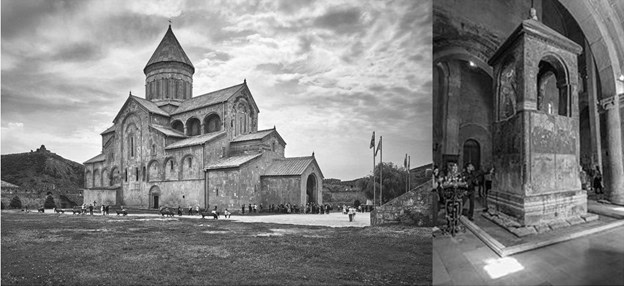
Above: Svetitskhoveli Cathedral in Georgia, and the ciborium under which the tunic is said to be buried
Getting back to Hollywood, a gross inaccuracy in The Robe is its portrayal of the Roman emperor Tiberius, and especially his successor Caligula, as enemies of Christianity. Tiberius tells Marcellus: “Miracles, disciples, slaves running away. . . . Tribune Gallio, I give you an imperial commission . . . . For Rome, seek out the followers of this dead magician. I want names, Tribune—names of all the disciples, of every man and woman who subscribe to this treason. Names, Tribune, all of them, no matter how much it costs or how long it takes.” Subsequently Tiberius hints to his advisors that Christianity may spell the doom of Rome.
But far more malevolent is the young Caligula (well played by 23-year-old actor Jay Robinson, who critics said virtually “stole the show”). Caligula denounces “These fanatics who call themselves Christians.” Marcellus meets secretly with Christians in what appear to be torch-lit catacombs, and says “Caligula has decreed against us.” At Marcellus’s trial, Caligula says: “Senators, Romans, as you know, there exists in our empire—and even in Rome itself—a secret party of seditionists who call themselves Christians. . . . They have enlisted in their ranks the riffraff of the plebian class as well as slaves.”
But all this was hogwash. There is zero historical evidence that either Tiberius or Caligula ever persecuted Christians. The Crucifixion and Resurrection are believed to have occurred circa 33 AD. Tiberius died in 37 AD, and his successor Caligula ruled from 37 to 41 AD, before the new faith of Christianity had made any significant inroads into Rome. The Apostle Paul did not arrive there until about 60 AD. Christians were certainly not “hiding out” in Rome from Caligula. That depiction seems to be something screenwriter Maltz picked up from watching Quo Vadis, which accurately depicts Nero’s persecution of Christians more than 20 years after Caligula.
Lloyd Davis’s original novel The Robe also mis-portrayed Tiberius and Caligula as foes of Christianity, but Maltz took it to new heights. Tiberius impossibly demanding the name of every Christian, who he says are guilty of “treason,” probably symbolized Maltz’s views of Joe McCarthy and of the House Committee on Un-American Activities “naming names” of communists as traitors. In the movie, Caligula’s denunciation of Christianity’s impact on “the riffraff of the plebian class as well as slaves” seems to be torn from Maltz’s communist ideology; he might have used the word “proletariat” had it not been an anachronism.
Why did Maltz portray Caligula as he did, when the latter never persecuted Christians? Caligula was an enemy of the Jews. He antagonized them by ordering that a giant statue of himself be placed in the still-standing temple in Jerusalem. The order resulted in massive protests, and was never carried out (Caligula was assassinated soon after).
NOTES
Endnote numbers are unchanged from the book.
- Hieromonk Makarios, The Synaxarion: The Lives of the Saints of the Orthodox Church, Volume 7, Translator Mother Maria (Rule) (USA: Sebastian Press, 2008), 99.
- . “Setitskhoveli Cathedral (Mtshketa, Georgia)” OrthodoxWiki, https://orthodoxwiki.org/Svetitskhoveli_Cathedral_(Mtskheta,_Georgia). “Seamless Robe of Jesus,” Wikipedia, https://en.wikipedia.org/wiki/Seamless_robe_of_Jesus.


