

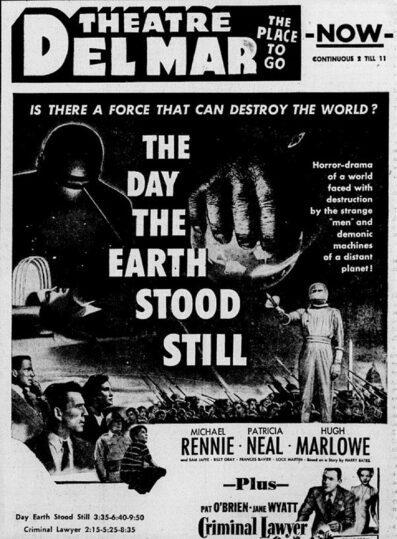
There were two versions of this movie (1951 and a 2008 remake). We’ll focus on the first, but won’t ignore the second.
A natural question to ask is “How could a movie made 75 years ago possibly predict the future?” George Orwell proved with his book 1984, published in 1949, that fiction can predict the future with a substantial degree of accuracy. You’ll find examples of Hollywood’s forecasting of 9/11 in my 2024 post if you scroll down to the section called “predictive programming.”
The main reason for Hollywood’s ability to engage in long-range predictive programming (as in The Day the Earth Stood Still) lies primarily in the Deep State’s satanic nature, a hierarchy that appears to consist simply of pedophile billionaires, politicians, and celebrities. But the reality is that, as the Apostle Paul said, “We wrestle not against flesh and blood, but against principalities, against powers, against the rulers of the darkness of this world, against spiritual wickedness in high places.” (Ephesians 6:12). Evil people live and die, but the ultimate overlords are not people; they are the demons, fallen angels, and—the ultimate “CEO” of the Deep State—Satan himself.
There is an old saying: “Satan never sleeps.” He was “in charge” hundreds of years ago, every bit as much as he is now, and that is why the New World Order has evolved continuously and so consistently over the centuries, always pursuing the same ultimate objective of a one-world government, whose ruler will be the Antichrist.
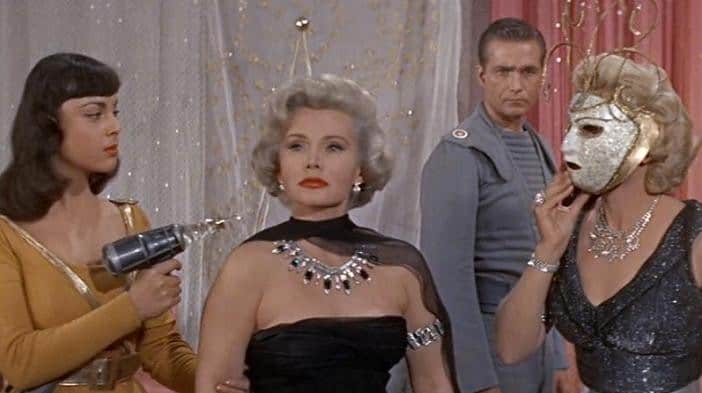
The 1950s saw a plethora of low-quality sci-fi movies, such as Queen of Outer Space (image below) starring Zsa-Zsa Gabor, Plan 9 from Outer Space, and many others. These films’ ineptness later made them unintentional comedies for TV late-show viewers.
The 1970s and 80s saw outer space/alien movies undergo the beginning of a huge makeover as a big-budget genre, with films like Close Encounters of the Third Kind, Star Wars, E.T., and Alien.
But one 1950s “flying saucer” film that bucked the then-trend of low quality was The Day the Earth Stood Still, about an alien named Klaatu who, accompanied by his robot Gort, descends on Washington, DC, in a spaceship, with a message for mankind. Some factors that distinguished this sci-fi film from others of its era:
• The director was the eminent Robert Wise, who directed such major classics as The Sound of Music and West Side Story.
• The music composer was Bernard Hermann, who scored numerous top films, such as Alfred Hitchcock’s North By Northwest and The Man Who Knew Too Much. The eerie sounds he created for The Day the Earth Stood Still was imitated by other sci-fi flicks that followed. (He later composed the menacing violin shrieks famously heard during Hitchcock’s Psycho shower scene.)
• According to IMDB, the interior of Klaatu’s spaceship was based on a design by legendary architect Frank Lloyd Wright.
• Well-known news journalists such as Drew Pearson did cameos in the movie, reporting the latest developments about the spaceship.
• At one point Klaatu visits the world’s smartest scientist (played by Jewish actor Sam Jaffe; it was an obvious reference to Albert Einstein). Klaatu corrects a lengthy equation on the professor’s blackboard—but these were no mere scribbles. As IMDB notes:
The equations seen on Professor Barnhardt’s blackboard are authentic physics that describe a particular form of the famous “three-body problem” in Newtonian gravitation, a problem which has no general closed-form solution. Such many-body problems are central to navigation in interstellar space. The manner of writing and organization of the terms show that a real physicist had produced the work.
Why did the movie generate an authentic, advanced physics equation, which more than 99 percent of viewers could not have recognized as such?
• Prominent actress Patricial Neal was selected to play the female lead. The part of Klaatu went to British actor Michael Rennie—then little-known to American filmgoers—but only because the producer realized audiences would have difficulty accepting a well-known star (such as Spencer Tracy or Gary Cooper) as an alien.
Why do I suggest that The Day the Earth Stood Still had predictive programming for today? Because major elements in the film are now converging.
• In 2026, in a major shift, the U.S. government declassified decades of documents related to UAPs (Unidentified Anomalous Phenomena). Why is there sudden transparency about UFOs, while so little transparency about the Epstein files, spending, corruption, and other matters?
• Reports of UAP sightings have increased, rising from 291 in 2022-2023 to 791 in 2023-2024, although some of the rise relates to reporting methods. The New Jersey sightings of 2024 even drew attention from Congress and President Trump.
• Recently there has been a pattern of strange deaths and disappearances of scientists and military personnel involved in UFO/UAP-related research.
• In 2025, the percentage of Americans who believe aliens have visited Earth was 47%, up from 36% in 2012.
Presumably one reason for the increase in acceptance of UFOS as real is Hollywood inundating the public with high-budget alien movies since the 1970s. But this isn’t to deny the reality of many sightings, a number of which have come from reliable witnesses, such as airline pilots. It appears that Hollywood conditioning and government transparency are now coinciding—possibly signaling that we are near a major UFO event.
I am aware, by the way, of the late Serge Monast’s discussion of Project Blue Beam, which entails a government-contrived fake alien invasion. While I would never put it past the Deep State to run an alien PSYOP, I do believe many of the sightings have been authentic.
In my 2016 post “Making Sense of the Natural,” I made the case (and I’m certainly not alone in this) that aliens are, in fact, fallen angels and demons—definitely not creatures from some far-away civilization.
And that’s what brings us squarely to The Day the Earth Stood Still. Perhaps its greatest deception was that aliens are benevolent beings.
• Klaatu conveys that aliens are normal-looking humans.
• Klaatu claims aliens have a morally superior civilization—one in which wars never happen.
• Klaatu depicts aliens as having far more advanced technology. For example, even though he is wounded by a gunshot from an over-zealous American soldier after emerging from the spaceship, he is able to heal himself by applying a unique salve. While he appears to be about 40 (Rennie was 42) Klaatu says he is 78, and that aliens have a life expectancy of 130. And he says that, where he lives, trains don’t need tracks—calling to mind today’s ultra-fast Maglev trains seen in China and Japan (although these trains follow tracks, they don’t touch them while in motion, propelled by superconducting magnets instead of fuel).
I must interject here that there is a “partial truth” in the concept of aliens having superior technology. The pre-Flood fallen angels were able to impress mankind with their technological knowledge. The book of Enoch isn’t part of the Bible’s official canon, but the Bible does reference Enoch. The book of Jude, for example, references content of Enoch in verse 6, and verses 14-15 loosely quote Enoch 1:9. Likewise 2 Peter 2:4 references content from Enoch. The book of Enoch is found in the Dead Sea Scrolls, and is part of the Ethiopic canon of scriptures. Enoch chapter 8 says of the fallen angels:
Moreover Azazyel taught men to make swords, knives, shields, breastplates, the fabrication of mirrors, and the workmanship of bracelets and ornaments, the use of paint, the beautifying of the eyebrows, the use of stones of every valuable and select kind, and of all sorts of dyes, so that the world became altered. Impiety increased; fornication multiplied; and they transgressed and corrupted all their ways. Amazarak taught all the sorcerers, and dividers of roots; Armers taught the solution of sorcery; Barkayal taught the observers of the stars; Akibeel taught signs; Tamiel taught astronomy; And Asaradel taught the motion of the moon. And men, being destroyed, cried out; and their voice reached to heaven.
Thus the book of Enoch confirms that fallen angels—whom we today mistakenly call “aliens”—brought new technologies to Earth. Since these angels were originally in heaven, they had celestial knowledge which humans lacked.
Another correlation in The Day the Earth Stood Still is that Klaatu emulates the powers of Christ (as the Antichrist will do). After he is shot dead by U.S. soldiers, his robot, Gort, takes him to the spaceship, where he temporarily resurrects him.
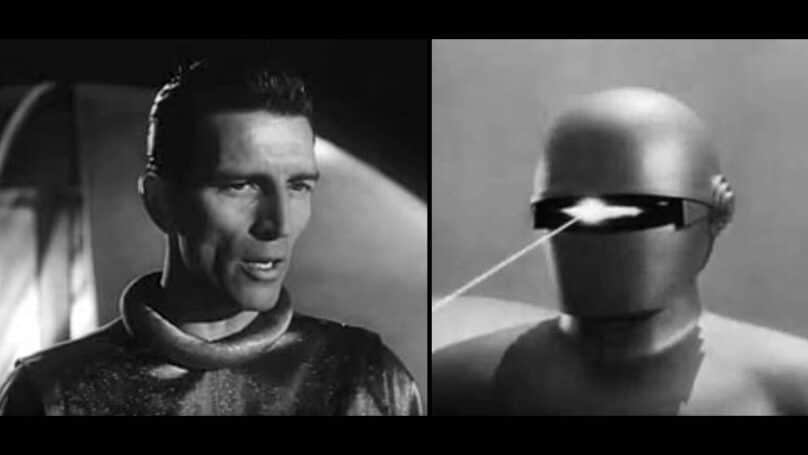
Actress Patricia Neal’s character, having just observed Klaatu’s resurrection, asks, “You mean he [Gort] has the power of life and death?” Klaatu responds, “No, that power is reserved for the Almighty Spirit.”
However, IMDB adds an important comment:
Klaatu’s resurrection at the end of the movie was meant to be permanent, reinforcing his God-like powers. The Breen Office, the film industry’s censors, didn’t like the ending, suggesting it was too left-wing, and insisted that director Robert Wise and writer Edmund H. North put in the line, “That power is reserved for the Almighty Spirit.” Wise and North hated the line; it negated the concept of Klaatu’s race being all-knowing and all-powerful. The studio wouldn’t back them up, so they were forced to put it in.
When Klaatu roams the streets of Washington incognito, he uses the name “Carpenter,” further implying that the alien is a substitute for Christ. And at the movie’s end, after making a speech warning the world about the danger of nuclear weapons, Klaatu (in his spaceship) ascends into the heavens—rather emulating Christ’s departure recorded in the Book of Acts, Chapter 1.
We know of course, that the Antichrist will perform “signs and wonders” in order to convince the world’s inhabitants that he is the Messiah.
But the element of nuclear weapons is another component that might cement the film to the near future. Klaatu says he has traveled 250 million miles, just to warn the people of Earth to stop building nukes. He mentions that humans will soon apply nuclear energy to spaceships, and “that will create a threat to the peace and security of other planets.” (The movie doesn’t explain how nuclear weapons built on Earth could threaten a civilization 250 million miles away.) According to Klaatu, aliens who inhabit other planets live in peace and security, a peace enforced by robots like Gort, who act as the police. (Note: at present, six countries, including the U.S., with China in the lead, have robots who function as police, with facial recognition capabilities. AI-run robots was another of the film’s “predictive programming” elements.)
In his final speech before departing, Klaatu says “It is no concern of ours how you run your planet, but if you threaten to extend your violence, this Earth of yours will be reduced to a burned-out cinder” (an ultimatum which seems like ironic overkill—the way to end potential violence is through real violence on a massive scale.)
Although Klaatu doesn’t destroy the planet, he demonstrates the aliens’ power by shutting down Earth’s electrical grid for 30 minutes (hence the title “The Day the Earth Stood Still”), calling to mind Klaus Schwab’s warning of a global cyber-attack.
Given concerns that the current Iran conflict could degenerate into nuclear war, we might ask if an “alien invasion”—whether a PSYOP or the actual intrusion of supernatural entities—might be timed to coincide with such a war, giving humans the illusion that “aliens” halted the war, and causing many people to hail them as saviors.
The 2008 Version
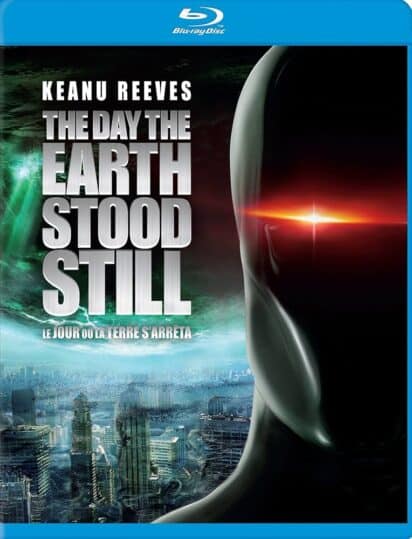
Remakes are seldom as good as originals, and if IMDB ratings are a measure of that, the 1951 version gets a healthy 7.7 out of 10 stars, while the second earns a mediocre 5.5.
The 2008 version keeps certain elements of the classic. The alien (Kenau Reeves) still looks human and is named Klaatu, and still heals his own wound. His robot is still named Gort, and retains some of the original’s look, though much larger. Klaatu lands in an orb instead of a flying saucer, and other orbs are said to be landing on Earth. As in the original film, the U.S. military is no match for the aliens. Klaatu still visits the world’s top scientist, Professor Barnhardt, correcting an equation.
Although Klaatu is not himself resurrected in this edition, he brings a dead policeman back to life, his character again usurping powers of the divine.
And the movie adds some dark Deep-State themes.
Klaatu says he came to save the Earth, but later clarifies this means saving the planet from humans, who are destroying it. The humans, he says, must be wiped out to save Earth. Other orbs are collecting the various animal species in order to repopulate the planet after its destruction—a sort of alien version of Noah’s Ark. He says: “We can’t risk the survival of the planet for the sake of one species.” In this are embodied several politically correct ideas:
• Darwinism. Nothing is special about people; they are just one more animal “species.”
• Environmentalism. The planet’s value is greater than humanity’s.
• Scapegoating average people. The world’s problem is not the Deep State. It’s regular people themselves, who are worsening climate change by their energy use.
• Depopulation. That’s the movie’s “solution,” and a long-standing agenda of the New World Order.
In the end, Klaatu changes his mind simply because he’s struck by the love that the lead female character (played by Jennifer Connelly) shows for her stepson who, evidently to keep the film politically correct, is Afro-American. Also politically correct: the U.S. Secretary of Defense is depicted as a woman.
Instead of wiping out humanity, when the aliens depart, they permanently shut down Earth’s power grid (presumably an environmentalist blow against climate change). Such a shutdown would, of course, kill a lot of humans anyway.
But while the 2008 remake suffused itself with “green” political correctness, I believe it is the 1951 original that still harbors the most dangerous predictive programming for today.


