OK, when I call something a “gem,” I almost always add a caveat, “what’s a gem for me may not be for thee.” Most of my readers know I appreciate the moral entertainment of long ago to most of what’s produced today. I also realize that much of what I say will be Greek to many younger readers.
In my 2018 article “The Real Reason There Was a ‘Golden Age of Television,’” I laid out why TV was initially so moral, and why—when the percentage of U.S. homes with a TV topped 90% for the first time, in 1963, the “magic moment” had arrived to drop the façade of traditional values and incrementally begin introducing “political correctness” wirelessly into homes. The distinction was enough that I could sense the subtle change myself beginning that fall of 1963—not the spring, mind you, but the new season that began in September. Kennedy’s assassination was weeks away; Tonkin Gulf and the Beatles were around the corner. America was about to undergo the sixties counterculture, and TV played its part.
OK, so what’s the “gem” I’m talking about? It’s:
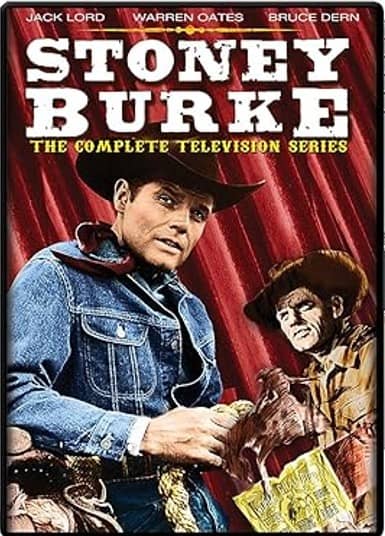
No, it wasn’t a “western.” It was about a modern rodeo rider from South Dakota. It starred Jack Lord six years before his iconic series Hawaii Five-O began. As Stoney Burke, Lord travels the country with his support crew. And while some episode plots centered on the rodeo, it was mostly about the people and adventures he and the crew encountered while on their journeys. In this respect, it resembled the classic show Route 66.
What makes this program impressive to me is the integrity of Stoney Burke—consistently a man of honor. He is deftly played off against by the low character of one his crew hands, Veis (Warren Oates), a ne’er-do-well always out for an easy buck (a little reminiscent of “Angel” of The Rockford Files)—but Veis still comes through for Stoney in the clutch. Future star Bruce Dern also played one of Stoney’s hands, though for some reason dropped out during the season’s second half. The show had no shortage of top guest stars, present and future, such as Robert Duvall, James Coburn, Steve Cochran, Caroll O’Connor, Mariette Hartley, and Cloris Leachman. Amazon customers give it 4.5 out of 5 stars, and IMDB 7.7 out of 10, so the show commands respect.
You can watch a few free episodes of Stoney Burke on a YouTube playlist. I’d recommend “Joby” guest-starring Robert Duvall. I liked the series enough that I bought the full DVD set (it’s not currently downloadable).
I asked AI why the series was cancelled. It answered: despite critical acclaim, the show had insufficient ratings, and the public was tiring of “westerns.” I doubt this explanation. As a newcomer, Stoney Burke had to compete in its timeslot against veteran shows with established followings, including The Danny Thomas Show (nine years on the air), The Price Is Right (six years), and Dr. Kildare (only one year, but so popular that it ranked #9 nationally in its first of five seasons). Also, Stoney Burke was not at all a “western” in the traditional sense of shows like Gunsmoke, Bonanza, Maverick or The Rifleman. (See my post on the craze that culminated with 30 different westerns airing on network television in 1959 alone.) Stoney Burke was set in modern times, not the Old West with a marshal facing an outlaw in a climactic showdown.
I personally believe Stoney Burke was cancelled because of its heart and high moral standards—standards that network TV executives had resolved to start discarding in autumn 1963. I may be wrong, of course, but it fits the pattern.